PrajnaEdge
A curiosphere for curious minds who want to understand, experiment with, and experience technology.

Technology is a system of connections.

Modern technology is built from layers that continuously interact with one another. At the physical level, electronic devices transform electrical signals into digital information. Digital logic turns that information into computation, while processors, memory and communication interfaces provide the machinery needed to execute instructions and move data. As these components become part of embedded systems, they begin to interact with the physical world through sensors, controllers, actuators and real-time software.

But computation does not exist in isolation. Operating systems coordinate hardware and software, firmware gives specialized machines their behaviour, and communication protocols allow independent systems to exchange information. At the same time, machine learning is moving beyond the cloud into edge and on-device systems, where models must operate within real constraints such as memory, processing power, latency and energy consumption.

PrajnaEdge explores these connections as one continuous technology landscape — and takes them beyond explanation. From computing foundations and embedded systems to intelligent machines and edge AI, ideas can be understood, experimented with, and eventually turned into technology that can be experienced in the real world.

To continue exploring
Products

Technology, made tangible.

PrajnaEdge products and technology experiences are currently in development.
In Development

Playground

Experiment with intelligence beyond the cloud.

AI inference performed closer to where data is generated — optimizing model representation to reduce latency, memory footprint, and bandwidth requirements.
Cloud AI Coming Soon

Model Training & Representation

Explore how neural networks learn representations from data before compression and deployment. Future experiments will allow adjusting learning parameters—such as learning rate, epoch counts, and batch sizes—to observe loss trajectories and decision boundaries.

Edge AI Computer Vision

Image Classification

Can this image classifier maintain its intelligence while becoming small enough for the edge?

On-device AI AI-Thinker ESP32-CAM

On-device Image Classification

Run a fully quantized INT8 image-classification model directly on embedded hardware.

Edge AI Playground

Image Classification

Can this image classifier maintain its intelligence while becoming small enough for the edge?

Choose an image

Upload an image
Supports JPG, JPEG, PNG
This classifier recognizes only Apple, Banana, and Orange. Other objects may be incorrectly classified as one of these classes.

Choose the model

Model size
4.91 MiB
Largest activation
~625 KiB
Test accuracy
99.11%
Measured model accuracy
Your image is processed locally in your browser.
On-device AI · Inference

On-device Image Classification

Run a fully quantized INT8 image-classification model directly on embedded hardware.

This experiment investigates preparing a compact INT8 TensorFlow Lite model for direct inference on resource-constrained embedded hardware. The model uses the same CNN architecture as the Edge AI exploration, converted to a full INT8 representation to classify three classes: Apple, Banana, and Orange.

Model size
1.23 MiB
INT8 quantized weights
Model accuracy
99.11%
Measured test accuracy
Target hardware
AI-Thinker ESP32-CAM
Embedded microcontroller target

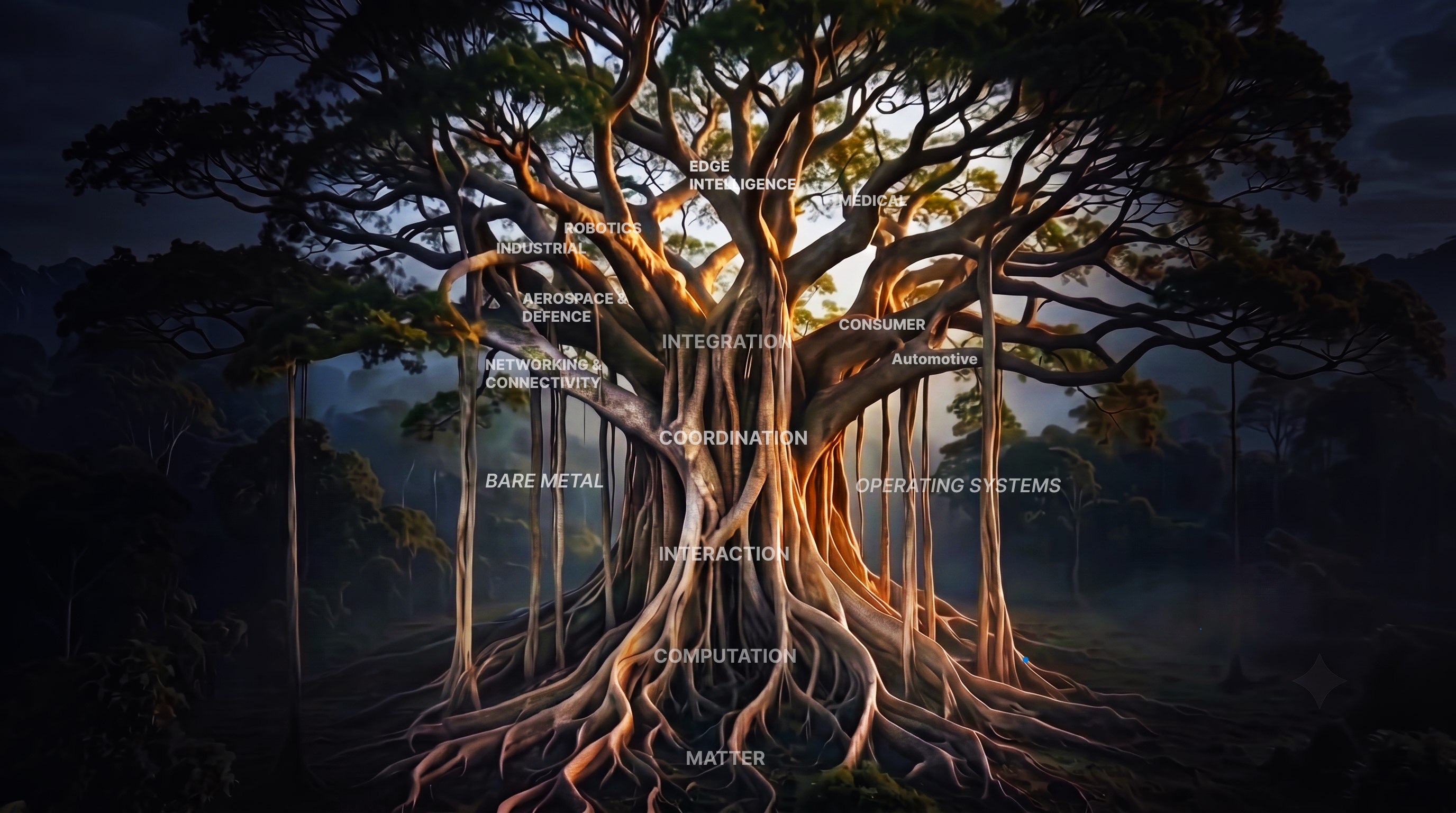
Explore the ideas, systems and connections that shape technology — choose any node to begin your journey.

PrajnaEdge Navigation Tree
Embedded Systems Tree
View Books →
PrajnaEdge Library

PrajnaEdge Library

Practical guides to embedded systems and engineering.

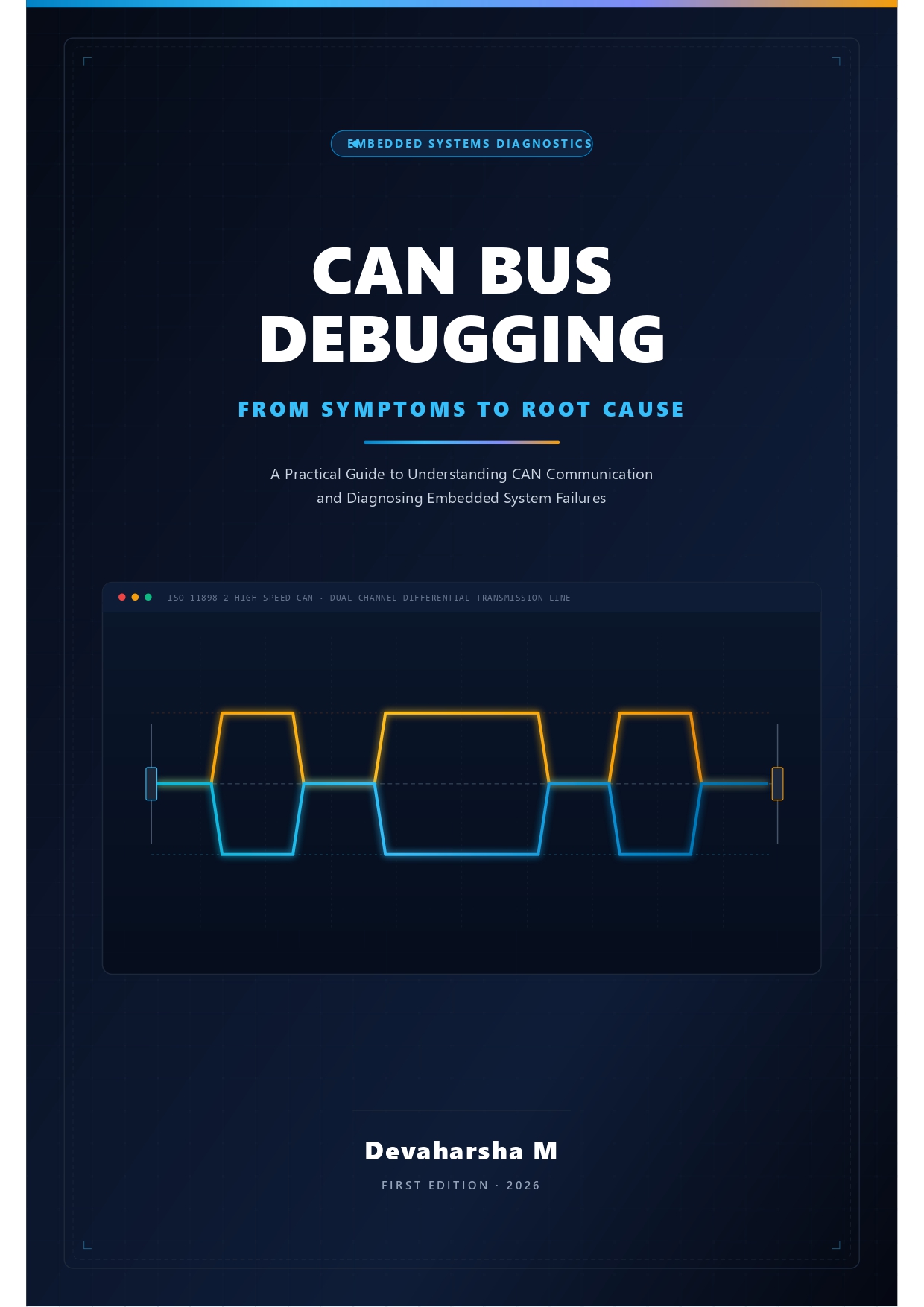
CAN Bus Debugging: From Symptoms to Root Cause Book Cover
Automotive · Embedded Protocol Debugging

CAN Bus Debugging: From Symptoms to Root Cause

  • Select
  • United States
  • United Kingdom
  • Germany
  • France
  • Spain
  • Italy
  • Netherlands
  • Japan
  • Brazil
  • Canada
  • Mexico
  • Australia
  • India

Edge AI Demonstrations

Deploying neural networks and intelligent decision loops on raw silicon targets.

Sort:
Coordination

When Hardware Learned to Interrupt

The moment machines stopped waiting.

InterruptsNVICPreemptionLatencyVector Table

1. A World of Waiting

In our previous exploration, we watched a simple bare-metal embedded loop scale from a single button check to a complex array of duties. The microcontroller had to check the UART console, query an ADC sensor, inspect a CAN bus register, and toggle diagnostic LEDs. The result was a monolithic loop:

while(1) { CheckButton(); CheckUART(); CheckADC(); CheckCAN(); }

This is polling. Its primary flaw is structural: it ties coordination entirely to the execution path of the software. The CPU spends almost all its time and power asking if something has happened, only to receive 'no' as an answer. It keeps the core running at 100% load, consuming maximum power simply to check idle pins. It is a system built on active waiting, where responsiveness degrades as more peripherals stretch the loop cycle time.

2. The Reversal

What if we could reverse this relationship? Instead of the central processor constantly interrogating passive hardware components, what if the hardware could announce events instead?

This is the core philosophy of Interrupts. Rather than the CPU spinning in a loop asking 'Has anything happened?', the hardware peripherals are given a dedicated channel to signal the CPU: 'Something happened. Act now.'

This simple reversal represents the most fundamental shift in embedded system architecture. It decouples event detection from the sequential flow of execution, freeing the CPU to execute background calculations or enter deep low-power sleep modes until the physical world demands its attention.

3. The Doorbell Analogy

To appreciate this shift, imagine waiting for a package delivery. Under a polling strategy, you must walk to the front door every ten seconds, open it, check the porch, close the door, and walk back. You can do nothing else; you are entirely consumed by the active wait.

An interrupt-driven approach equips the door with a bell. You sit down, read a book, or fall asleep. The visitor arrives and presses the button. The bell rings, interrupting your activity. You bookmark your page, answer the door, sign for the package, and return to exactly where you left off. The active checking is gone, replaced by a reactive trigger.

4. The Anatomy of an Interrupt

How does this handoff occur in raw silicon? When an external event occurs—such as a button pin falling low or a byte arriving in a UART buffer—the peripheral asserts a physical interrupt request (IRQ) line connected to the processor core. The hardware handoff then unfolds automatically:

1. Assertion: The peripheral drives its IRQ line to its active state (high or low). 2. Synchronization: The core detects the active line and waits to finish its currently executing machine instruction (typically 1 to 5 clock cycles). 3. Context Saving: The CPU automatically halts normal execution and pushes its current register states (such as the Program Counter, Link Register, Stack Pointer, and Status Register) onto the stack. This preserves the exact state of the background program. 4. Vector Fetch: The processor reads the vector table to fetch the memory address of the handler function associated with the triggering IRQ. 5. Execution: The Program Counter jumps to that address, and the CPU begins executing the Interrupt Service Routine (ISR). 6. Return: Once the handler finishes, it executes a special return instruction. The CPU pops the saved registers back off the stack, restoring the CPU state, and resumes the background program exactly where it was paused.
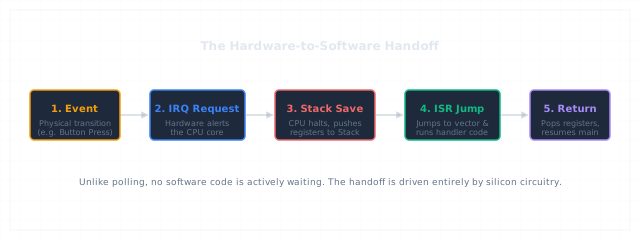
The step-by-step lifecycle of an interrupt request handoff.

5. Interrupt Latency

While interrupts resolve the polling delay bottleneck, they do not respond instantly. In embedded systems engineering, Interrupt Latency is the exact delay between the assertion of the hardware IRQ line and the execution of the first instruction in the ISR.

Latency is a hardware tax composed of several parts: completing the current instruction, pushing CPU registers onto the stack (stacking), syncing clocks between the peripheral bus and core, and executing entry handler routines. In modern ARM Cortex-M processors, this hardware stacking and lookup process is heavily optimized, taking as few as 12 to 24 clock cycles. But in real-time systems, every cycle counts. If another interrupt is already running or interrupts are temporarily disabled by the driver, this latency can stretch, potentially causing missed deadlines.
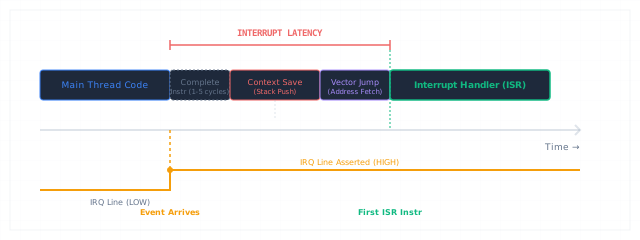
The timing breakdown of hardware stacking and vector fetch latencies.

6. Priority and Preemption

A real embedded system has multiple interrupt sources. What happens if a button press occurs at the exact same millisecond a critical CAN network alarm frame arrives? How does the hardware choose?

This is solved by Interrupt Priority. Every interrupt source is assigned a priority value. When multiple IRQ lines are asserted simultaneously, the core's hardware interrupt controller (such as the Nested Vectored Interrupt Controller, or NVIC, in ARM architectures) compares their values and runs the highest-priority handler first. If a lower-priority handler is already running when a higher-priority event arrives, the hardware executes Preemption—instantly pausing the lower-priority ISR, pushing its registers to the stack, and running the higher-priority ISR. Only when the high-priority handler completes does the lower-priority handler resume.
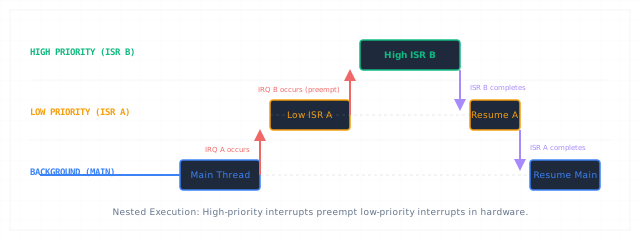
A multi-lane timing diagram visualizing preemption and context nesting.

7. Nested Interrupts

This ability to preempt running handlers is called Nesting. Without nesting, a slow, low-priority handler (like a periodic temperature readout) would block a high-speed critical line (like a motor safety trip signal) for milliseconds, defeating the real-time guarantees of the system.

Prioritization and nesting ensure that critical routines remain deterministic, regardless of other activities. However, nesting also introduces a system risk: stack depth. Each nested layer pushes more registers onto the RAM stack. If too many interrupts nest, the stack can overrun into application variables, leading to silent memory corruption.

8. The Vector Table

How does the hardware translate a physical IRQ number into a software function address? It reads the Vector Table.

The Vector Table is an array of function pointers placed at a fixed location in memory (typically at the very bottom of the Flash partition, 0x0000_0000 or 0x0800_0000). Each index corresponds to a specific hardware line: index 0 is the initial stack pointer, index 1 is the Reset Vector, index 2 is the Non-Maskable Interrupt (NMI), and subsequent indices map to internal faults, timers, and external peripherals.

When a peripheral triggers, the processor uses the IRQ index to offset into this table, reads the 32-bit address stored there, and jumps directly to that address. You may recognize the first entries from The First Instruction: the Reset Vector is simply the very first interrupt address fetched by the silicon when power is applied.
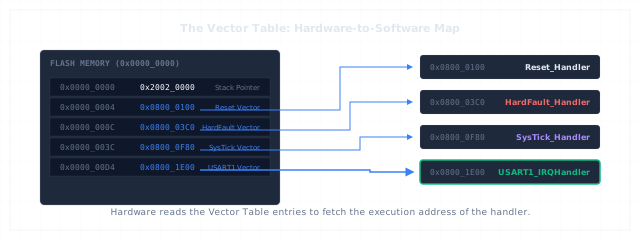
The mapping between hardware address indexes and handler code in flash.

9. Real Embedded Examples

Interrupts are the invisible coordination layer of modern electronics. In a UART interface, an interrupt triggers each time a character lands in the receive register, ensuring the CPU extracts it before it is overwritten. In a motor control loop, timer compare interrupts trigger microsecond-aligned PWM adjustments. In safety systems, CAN controllers trigger emergency handlers the moment an error frame is detected.

By replacing active waiting with reactive notifications, interrupts allow microcontrollers to sleep when inactive and respond with microsecond precision when needed. They represent the moment hardware became coordinate-aware.

The Limits of Response

Polling wasted CPU time by constantly asking if anything happened. Interrupts solved this by reversing the relationship, allowing the hardware to announce its readiness directly to the core.

But as system speeds continued to climb, a new engineering limit emerged. Imagine a high-speed network transceiver receiving thousands of bytes every millisecond, or an ADC sampling at megahertz rates. If the CPU must pause, save registers, jump to an ISR, extract a byte, restore registers, and return for every single byte, the processor is quickly overwhelmed.

The CPU now spends less time waiting, but it spends all of its time responding. Handling the data has become more expensive than detecting it.

To break this bottleneck, data needed to be moved directly from hardware to memory without involving the CPU at all. That need would lead directly to Direct Memory Access.

Interrupts freed the processor from active waiting, but as speed scaled, the core became a victim of its own responsiveness.
System Tree Node Coordination

PrajnaEdge

Engineering concepts you don't just read — you experience.
Founded in 2026.

PrajnaEdge is a technology company exploring the space between understanding technology, experimenting with ideas, and turning them into things that can be experienced.

Our Mission

To make technology easier to explore, deeper to understand, and more exciting to experience.

Our Vision

To build a technology ecosystem where curiosity, experimentation and creation continuously lead to one another.

Where it began

Embedded Systems

PrajnaEdge began with Embedded Systems — exploring the foundations that connect hardware, software and intelligent computation.

The first technology universe is built around that foundation. The journey will expand as new ideas, experiments and products emerge.

PrajnaEdge is a technology company created by Devaharsha Meesarapu.

CREATOR PROFILE

Devaharsha Meesarapu

Embedded Systems • Firmware • Edge AI

I am the engineer behind the design, development, and content of PrajnaEdge. I build low-level systems where code directly controls hardware, bridging the gap between register-level silicon behavior and intelligent edge decision loops.

View Resume →

ABOUT ME

I am an Embedded Firmware Engineer focused on developing software for resource-constrained systems. My experience spans bare-metal firmware, device drivers, microcontroller peripherals, and communication protocols, working across the boundary between hardware and software.

My work has involved microcontroller-based systems, real-time behaviour, hardware interfaces, and communication technologies such as CAN, CAN FD, UART, SPI, and I²C. I am particularly interested in understanding systems from the lowest level upward—from registers and peripherals to intelligent edge systems.

ENGINEERING PHILOSOPHY

Engineering is not just about writing code; it is about managing constraints, timings, and physical hardware characteristics. True mastery of complex systems comes from understanding the interactions across different layers of the stack.

This conviction is why I built PrajnaEdge—to bridge the gap between conceptual theory and direct, register-level physical reality.

CONNECT

LinkedIn → GitHub →

Interactive Career Journey

BTech · ECE

Foundations

Where it all began — understanding the physical layer of computation. Circuits, signals, and systems gave me a mental model of how information moves through hardware.

⬡
Connects to Systems
Understanding circuits directly enables writing firmware that talks to peripherals at the register level.
What it is
BTech in Electronics and Communication
Undergraduate foundation covering analog & digital circuits, signal processing, microprocessors, and communication systems.
CircuitsSignal ProcessingMicroprocessorsVLSI
What I did
Core Engineering Fundamentals
Studied semiconductor physics, digital logic design, and embedded microcontrollers. Built prototypes using 8-bit MCUs.
8051Logic DesignPCB Basics
What I learned
The Hardware Mental Model
Every software abstraction sits on physical reality. Understanding silicon teaches you why timing, power, and noise are first-class engineering problems.
Let's Connect
Interested in embedded systems, AI, or building something meaningful? I'd love to hear from you.
Open to collaborations, research, and interesting engineering conversations.
Help Improve PrajnaEdge
Found something to improve? I'd love to hear your thoughts.

Bare Metal

Software that runs directly on hardware without an operating system.

Applications
↑
Operating Systems
YOU ARE HERE
Bare Metal
Processor
↑
Hardware

"Every embedded application begins long before main()."

Operating Systems

An Operating System manages hardware and software resources so complex applications can work efficiently.

Applications
↑
YOU ARE HERE
Operating Systems
Bare Metal
↑
Processor
↑
Hardware

"When one loop is no longer enough to carry the burden."

← Return to Systems Tree
Select Domain
Explore application domains branching from the Systems Tree
Automotive
Aerospace & Defence
Consumer
Embedded AI
Industrial
Medical
Multimedia
Network & Connectivity
Robotics
Explore Active Systems Tree →
← Return to Systems Tree
Select Depth
Examine computation through architectural depth layers
Architecture
Controller
Digital
Programming
Processor
Explore Processors → Explore Controllers →

Support PrajnaEdge

PrajnaEdge is an independent education platform built to make knowledge freely accessible.

If you find PrajnaEdge useful, you can support its continued development.

Your support helps fund the time, tools, infrastructure, and experimentation that go into building and maintaining PrajnaEdge.

Select Region
Select Amount
Select an amount to support PrajnaEdge.